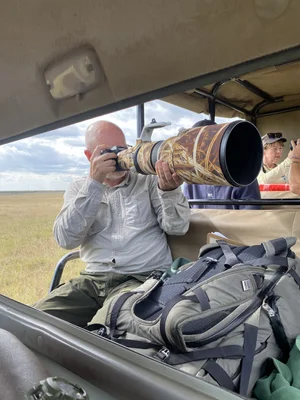
Photographing Adders in the UK

The adder (Vipera berus) is the UK’s only venomous snake and one of the country’s most recognisable reptiles, usually identified by the distinctive dark zigzag pattern running along its back.
Over the years I have encountered adders in several parts of the UK, including Scotland, Shropshire and Gloucestershire. In recent years, however, I have regularly visited a nature reserve in Leicestershire where there is a relatively high density of adders within a small area of suitable habitat. It has become my most reliable location for observing and photographing this remarkable species.
Photographing adders requires patience, careful observation, and a strong commitment to ethical wildlife photography. They are shy animals that rely on basking to regulate their body temperature, and disturbance can cause them to abandon important basking or breeding areas.
For photographers, the priority should always be to capture images without influencing the animal’s natural behaviour.
Understanding the adder
Adders vary in colour from pale grey and silver tones to deeper brown or almost completely black individuals. Males are typically lighter in colour than females, while females often appear darker and more heavily patterned.
They favour habitats such as heathland, woodland edges, rough grassland and sunny south-facing banks where they can bask after emerging from hibernation.
Adders spend much of the winter in hibernation, usually from October through to March. When they emerge in early spring they spend long periods basking in sunlight to rebuild energy reserves after the winter months.
Despite their venom, adders are extremely shy animals and rarely bite humans. Most bites occur when a snake is accidentally stepped on or deliberately handled.
A species under pressure
Adder populations in the UK are declining significantly, and conservationists warn that they may disappear from many parts of the country if current trends continue.
Adder on the move
Habitat loss and fragmentation remain the biggest threats. Development, agricultural intensification and changes in land management can destroy the mosaic of open ground and cover that adders require.
Human disturbance is another growing concern. Because adders rely on basking sites to regulate body temperature, frequent disturbance from walkers, dog owners or photographers can cause them to abandon these locations altogether.
Predation pressure may also be increasing in some areas, particularly where large numbers of pheasants are released for shooting.
Despite being protected under the Wildlife and Countryside Act 1981, adder populations continue to decline in many areas of Britain.
Organisations such as Amphibian and Reptile Conservation (ARC) and local Amphibian and Reptile Groups continue to monitor populations and promote habitat protection initiatives such as the “Make the Adder Count” project.
Behaviour photographers should understand
Adders are highly site-faithful animals and often return to the same basking areas, foraging spots and hibernation sites year after year.
These locations are usually sunny areas close to vegetation that allows the snake to retreat quickly if disturbed.
If an adder disappears into cover it will often return to the same basking spot once it feels safe again. Because of this behaviour it is important not to repeatedly disturb individuals or reveal specific locations publicly.
Protecting these sites is critical for the survival of local populations.
Shedding and seasonal behaviour
Adders shed their skin several times throughout the year.
Before shedding, their eyes turn cloudy or milky in appearance, which significantly reduces their vision. During this time they often remain hidden in vegetation to avoid predators.
They may still bask occasionally to maintain body temperature and will sometimes rub against rough surfaces such as vegetation, stones or branches to help remove the old skin.
After shedding, their colours often appear particularly vibrant, with males showing brighter silvery-grey tones and females appearing richer brown.
Ethical photography practices
Photographing adders responsibly is essential to ensure photographers do not contribute to the decline of this already vulnerable species.
Maintaining distance is the most important principle. A telephoto lens of at least 300mm is recommended, and it is always better to crop an image later than risk disturbing the snake by moving too close.
Movements should be slow and deliberate, as snakes are sensitive to ground vibrations.
Photographs should always be taken in situ. Snakes should never be moved, handled or repositioned for photographic purposes.
Time spent with an individual snake should also be kept relatively brief, allowing it to return to normal behaviour without prolonged disturbance.
Precise locations should never be shared publicly on social media.
Recognising defensive behaviour
Adders almost always attempt to escape when disturbed.
However, if they feel cornered or threatened they may adopt a defensive posture. The snake may raise the front portion of its body and form an “S” shape, which allows it to strike quickly if necessary.
In some situations a threatened adder may also produce a short defensive hiss as a warning.
If this behaviour is observed, the safest and most responsible response is simply to step back and allow the snake to retreat.
Photographing adders in the field

Common lizard basking
My own approach to photographing adders focuses on maintaining distance and allowing the animal to behave naturally.
A telephoto zoom lens such as a 100–400mm works particularly well, allowing flexibility while maintaining a safe distance.
I always work handheld when photographing adders. Using a tripod risks placing legs too close to the snake without realising it.
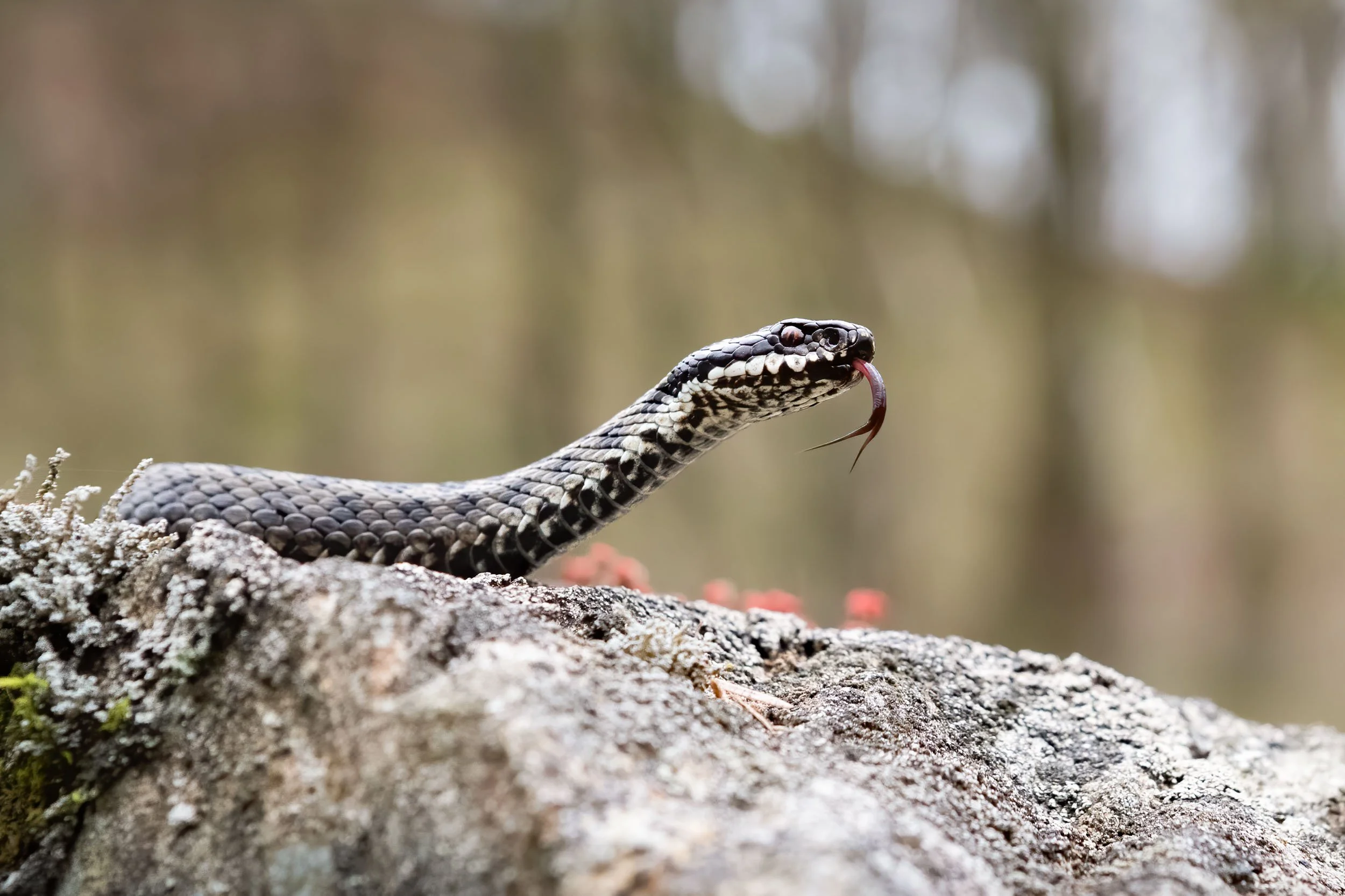
When the opportunity presents itself, photographing from eye level can create far more engaging images. This sometimes happens naturally when an adder is basking on a bank or rock slightly above the photographer.
Moving slowly is essential. Adders are extremely sensitive to vibration and can disappear into vegetation before you even realise they are present.
Binoculars can also be useful when scanning likely basking areas. From a distance a coiled adder can resemble a small dark shape on the ground and is surprisingly easy to overlook.
Adders often share habitat with other reptiles, and I frequently encounter common lizards in the same areas while searching. On one occasion at the Leicestershire site I also had a brief sighting of a grass snake moving through the vegetation.
The adder dance
One of the most remarkable behaviours associated with adders is the so-called “adder dance”.
This occurs in spring when male adders compete for access to females. Two males rear up and intertwine their bodies in a ritualised wrestling match, attempting to force their rival to the ground.
Despite the intensity of the encounter, biting rarely occurs. The goal is simply to establish dominance and secure mating rights.
It is one of the most fascinating wildlife spectacles in the UK, although I have yet to witness it myself. On more than one occasion I have met other photographers at the site who have told me, with a smile, that I should have been there the day before.
Are you interested in an adder photography workshop?
I am planning a small, low-disturbance Adder Photography Workshop for March / April 2027.
The exact location will not be shared publicly due to the sensitivity of the site, and sessions will be kept to 1-to-1 or 2-to-1. Dates will be weather-dependent, as adders need suitable conditions to bask and become active
Final thoughts
Photographing adders is very different from photographing larger wildlife.
Success often depends on patience, careful observation and a willingness to move slowly through suitable habitat while paying close attention to the ground.
When approached responsibly, it can be an incredibly rewarding subject. Few wildlife encounters in the UK feel quite as special as discovering an adder basking quietly in the morning sunlight.
Experiences like this also highlight the importance of protecting the fragile habitats these animals depend on.
Whatever you photograph, have fun.
If you are planning to photograph adders

Close-up of adder at eye-level. Its important to know that this image was taken from a safe distance and has been heavily cropped.
Maintain a distance of at least three metres
Use telephoto lenses rather than approaching too closely
Move slowly to minimise ground vibrations
Avoid casting shadows over the snake
Never touch, handle or reposition a snake
Keep visits brief to avoid repeated disturbance
Do not reveal exact locations publicly