Photographing Wildlife in Chobe National Park

Chobe offers something that few parks manage to balance so well: diversity. Large mammals, predators, and prolific birdlife all share the same landscape, shaped by the Chobe River, especially during the dry season when water sources become limited.
While elephants were the original reason I wanted to return, the more research I did the more appealing Chobe became as a place to learn, observe, and photograph a wide range of species from both land and water. The opportunity to combine traditional game drives with a dedicated photography workshop was a major factor in my decision.
The primary focus of my trip was a photography workshop with Pangolin Safaris. I chose to arrive a few days early and stay at Sandpiper Villas, joining several land based safaris with local guide Andrew. This allowed me time to acclimatise, get comfortable with my camera again, and sharpen my instincts in the field before the workshop began. Staying an extra night at the end of the trip also provided a chance to decompress before travelling home, while giving me the opportunity to join one final additional land based safari.
Land based safaris in the dry season
I visited during the dry season, which is often recommended for land based safaris in Chobe. With limited water away from the river, wildlife becomes easier to locate and the lack of long grass improves visibility.
Even on land based drives the river is never far away. We regularly encountered elephants moving to and from the water, often with wet legs, reinforcing how central the river is to daily life in the park.
Predators were most active early in the morning and later in the afternoon. Midday often meant resting lions and little movement, but patience was frequently rewarded.

Leopard strolling through the undergrowth is distracted by a bird of prey
Leopards in Chobe: rare and unforgettable
Before travelling, I had a detailed Zoom discussion with the Pangolin Safaris team about the wildlife behaviour and moments I most hoped to photograph. One of my main motivations was to capture elephants in and around the river, something I had missed the previous year when a river cruise in Chobe ended early after two boats became stuck in reeds before we reached the elephants.
I also mentioned that I still needed a leopard to complete my ‘Big Five’, having seen the other four in South Africa the year before. Pangolin were honest from the outset. Leopards in Chobe are never guaranteed and sightings are considered rare. They even suggested extending the trip into the Okavango Delta to improve my chances, but this was beyond my budget. I arrived in Botswana with realistic expectations and a sense that a leopard would be a bonus rather than a certainty.
That is why my first leopard sighting was such a powerful moment.
It happened on my very first land based drive with Andrew. The leopard was resting in a tree and at one point looked directly down the lens of my camera. For a brief moment it felt like a direct connection. The intensity of that stare is something I will never forget, and the images from that encounter remain some of my most treasured photographs from the trip.
The sighting became even more remarkable when a second leopard appeared nearby, believed to be its sister. Several vehicles were present, but the guides worked patiently and respectfully, taking turns and allowing everyone time to observe. At one point both leopards walked calmly between the stationary vehicles before crossing the track and disappearing out of sight in the direction of the river. They were never close together for long and did not interact, but simply witnessing two leopards moving freely through their environment was unforgettable. Nothing truly prepares you for your first leopard encounter.
My second sighting also came with Andrew, this time involving a female guarding an impala kill in a tree. The scene attracted several vehicles, and I found myself on the wrong side of a full vehicle, eventually sitting on the floor and shooting through a narrow gap between fellow passengers. Challenging and frustrating, but still an extraordinary privilege to witness.
The third and fourth sightings took place later during the Pangolin photography workshop, both again involving individual animals. Each encounter felt different and reinforced how unpredictable and special leopard sightings can be.
The workshop itself included a small group of four guests and two experienced photographic hosts, which further shaped how I approached wildlife observation and patience in the field. For the first three nights we stayed aboard a Pangolin houseboat on the Chobe River before moving to the purpose built Pangolin Chobe Hotel in Kasane for the remainder of the workshop. While the accommodation and fully inclusive food and drink were extremely comfortable, the schedule remained intensive, with early morning and afternoon safaris each day, alternating between the river and land. I cover the river based experience in more detail in the companion Chobe River guide.
A lion kill with Pangolin Safaris
One of the most intense moments of the trip came during a land based safari with Pangolin Safaris, guided by Dan.
Dan had received word that a pride of lions was on the move and positioned the vehicle ahead of where they were heading. When he switched off the engine, we suddenly realised we were in the middle of something unfolding. The pride was approaching from one side, while a herd of impala stood grazing on the other.
At first the lions moved calmly, spread out across the landscape and including several cubs that looked to be between twelve and eighteen months old. Nothing about their behaviour immediately suggested a hunt. Then everything changed.
The lions began moving faster, their focus suddenly clear. Alarm calls erupted from the impala as the herd scattered in every direction. We watched lionesses chasing impala through the bushes on both sides of the vehicle. Although we never saw the exact moment of the kill, the sounds alone told the story.
Dan carefully repositioned the Land Cruiser so we could see what had happened. The pride had brought down an impala and the feeding had already begun. Lionesses and cubs crowded around the carcass, growling and pulling at the meat while the sounds of bone and flesh tearing filled the air. Blood covered the faces of several lions and the energy around the kill was chaotic and raw.

Lionesses and cubs feeding on a female impala
After several minutes of frantic feeding we noticed a large male lion approaching the kill. The lionesses had clearly seen him too. Almost immediately they grabbed what they could and began to move away, leaving the male to feed alongside the cubs. The shift in behaviour was immediate and a powerful reminder of the hierarchy within a pride.
We stayed for a few minutes longer before quietly moving on, leaving the lions to finish their meal.
It was difficult to watch at times, but it was also an extraordinary reminder of how life in the wild truly works. Moments like this are not staged or predictable. They unfold quickly and leave a lasting impression on anyone lucky enough to witness them.
Land based safaris with Sandpiper Villas
The land based safaris I joined with Andrew at Sandpiper Villas were more traditional game drives, but I was very fortunate with timing.
On my first and third outings I was the only guest in the vehicle with Andrew, which effectively turned them into private drives. That was never something I expected and certainly not something I had planned for, but it gave me valuable time to settle back into my camera, ask questions, and reacquaint myself with shooting from a safari vehicle. It also meant we could spend longer with individual sightings and, where possible, ask Andrew to manoeuvre the vehicle into a better position for light and background.
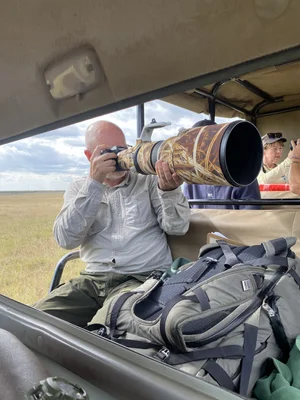
On another drive we were joined by other guests staying at Sandpiper. Like most traditional safaris, the experience was shaped by a shared desire to see as much wildlife as possible. Some guests were photographing, others were simply enjoying the sightings, but everyone shared the same excitement when something special appeared. After a few comments about the size of my lens, we all settled into the rhythm of the drive and enjoyed the encounters together.
Those quieter one to one drives with Andrew were incredibly helpful before the photography workshop began. They allowed me to get my eye back in, refine camera settings, and rebuild a little muscle memory in the field.
The Pangolin workshop that followed was quite different. Their safaris are designed specifically for photographers, with smaller groups and more time spent positioning carefully for light, behaviour, and composition.
Birdlife on land

Lilac breasted roller fly past
Birdlife was ever present and reinforced that Chobe is not only about large mammals.
One of my personal highlights on land was repeated sightings of lilac breasted rollers. Their colours stand out even in the muted tones of the dry season and they offered constant photographic opportunities between larger sightings.
Photographic challenges on land
Photographing from safari vehicles comes with limitations. You are elevated, often shooting down rather than at eye level. Movement is restricted and composition is dictated by vehicle position, other guests and surrounding vehicles.
Light can be harsh, dust is everywhere and changing lenses carries real risk. Zoom lenses often make more sense than primes on land, especially when action unfolds quickly.
Crowds were rarely an issue for me, aside from early morning queues at the park gates and busy leopard sightings. In general guides were cooperative and respectful, taking turns and prioritising the welfare of the animals.
Final thoughts
The land based side of Chobe exceeded my expectations. While elephants were my original motivation for returning to Botswana, the predator encounters, birdlife and the emotional impact of moments like my first leopard sighting and the lion kill made this an unforgettable experience.
What stood out most was the quality of guiding and the sense of privilege that comes from being present when something truly wild unfolds.
I also enjoyed some amazing encounters on the Chobe River, which you can read about in my separate guide Photographing Wildlife on the Chobe River.
Whatever you photograph, have fun.
If you’re planning your own Chobe National Park photography trip

Red billed oxpecker perched on a giraffe’s neck
Early mornings and late afternoons offer the best predator activity
The dry season improves visibility and concentrates wildlife near water
Be prepared to adapt quickly when action unfolds
Zoom lenses are often more practical than primes on land based safaris
Dust management is essential when changing lenses
Accept that luck plays a role and that rarity is part of the experience
Useful links
This guide is part of my On Location wildlife photography series, where I share practical advice and real life experiences from photographing wildlife in the UK, Europe and Africa.