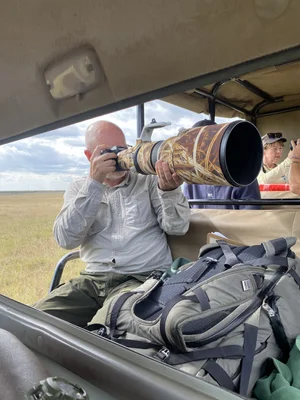
Photographing Wildlife at Nairobi National Park
Nairobi National Park offers one of the most unusual wildlife photography settings in Africa. Located on the edge of Kenya’s capital city, it is one of the few places in the world where wild animals can be photographed against the skyline of a major urban centre.
I visited the park on my first morning in Kenya in September 2025, shortly before travelling west from Nairobi to begin my conservation volunteering project in the Greater Maasai Mara ecosystem. The safari was never intended to be the main event of the trip, but rather a chance to experience my first wildlife encounters in Kenya and reacquaint myself with photographing from a safari vehicle.
Even as a short introduction to the country, the experience offered some memorable moments and a fascinating glimpse into one of Africa’s most unique national parks.
Arrival in Nairobi
I arrived at Jomo Kenyatta International Airport late on a Saturday night. After the long process through passport control and baggage reclaim, I made my way outside the terminal scanning the crowd of drivers and guides holding signs for arriving guests.
Once I located the driver holding my name, I was transferred to my overnight accommodation at Masai Lodge, located within easy reach of Nairobi National Park.
Knowing that I would be travelling west the following afternoon to begin my volunteering programme, I had arranged a morning safari with the lodge so that I could visit the park before leaving Nairobi.
Entering Nairobi National Park
My guide for the morning was Tony, an independent local guide who arrived at the lodge at around 6am.
Nairobi National Park opens at 6am, which meant we were already slightly behind schedule before we even left the lodge. Unfortunately the lodge took a little longer than expected preparing our packed lunches, which delayed our departure further.
We initially attempted to enter the park through a smaller gate closer to the lodge, but quickly discovered that it did not accept credit card payments.
We then made our way to the main entrance instead.
In hindsight I probably should have tried to organise park entry in advance. I had raised this possibility with the lodge before arriving but was assured it would be straightforward to pay at the gate.
Even after reaching the main entrance, however, the payment process still took around forty minutes to complete. By the time we finally entered the park it was around 7:45am, roughly ninety minutes after leaving the lodge.
As with most safaris, the earlier you enter the park the better your chances of seeing active wildlife.
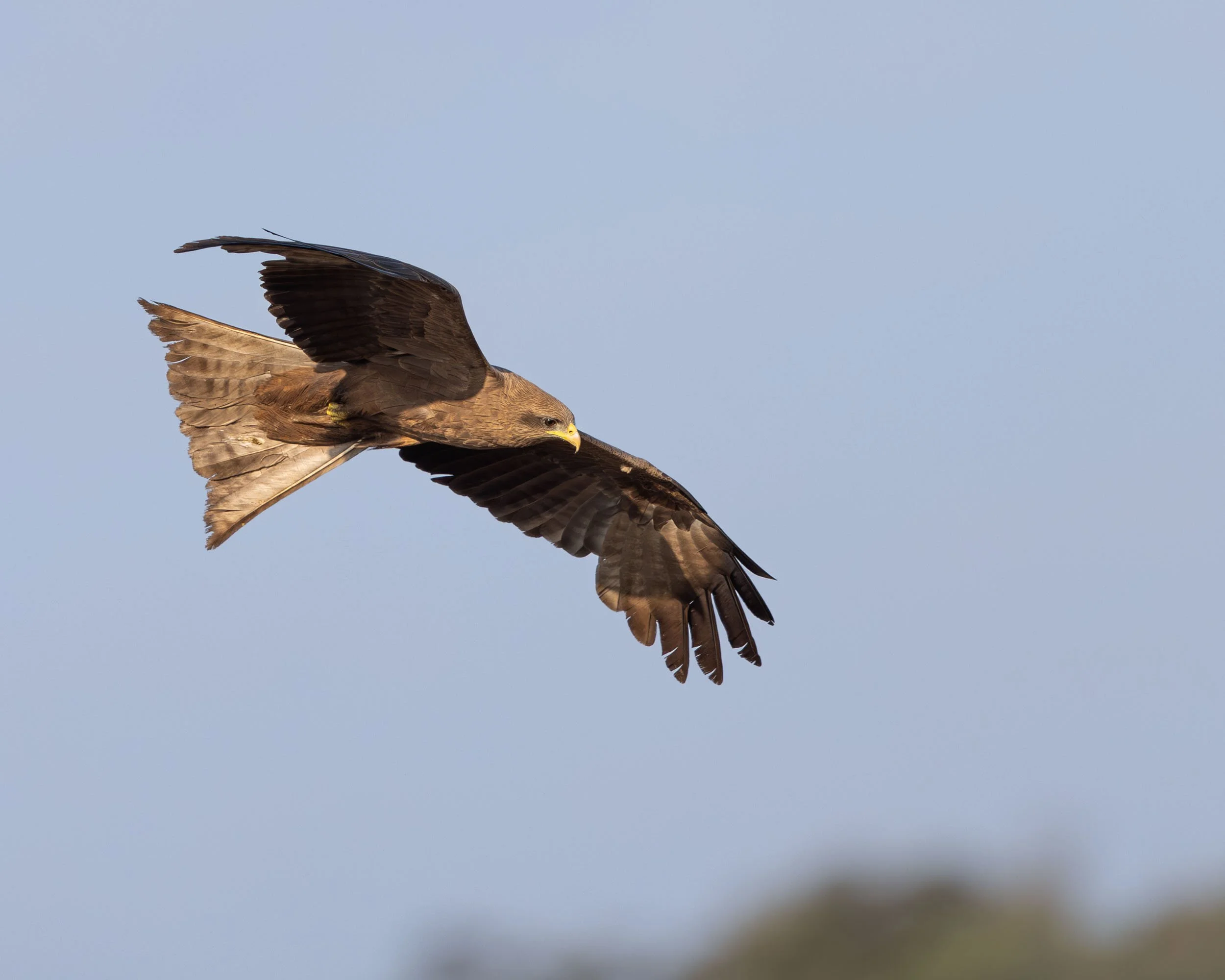
Yellow billed kite
First sightings at Nargoman Dam
Our first stop inside the park was Nargoman Dam, a small waterbody that often attracts birds and other wildlife.
From a distance we could see several hippos in the water, along with sacred ibis, marabou storks and a few smaller wading birds. It was also where I photographed my first yellow-billed kite.
While wildlife activity was fairly quiet, it was still exciting to photograph a species I had not seen before.
Rhinos and the Nairobi skyline
Nairobi National Park is one of the most important rhino sanctuaries in Kenya and plays a significant role in the country’s conservation efforts.
The park supports both eastern black rhinos and southern white rhinos within a heavily protected environment. Because of this protection and successful breeding programmes, it is often referred to as a “Kifaru Ark”, acting as a secure sanctuary for the species.
Our first rhino sightings were distant black rhinos, but the long grass and shrubs meant that most of their bodies remained hidden from view.
Eventually we found several white rhinos grazing in more open ground. As they fed they would occasionally lift their heads, giving me brief opportunities to photograph them.
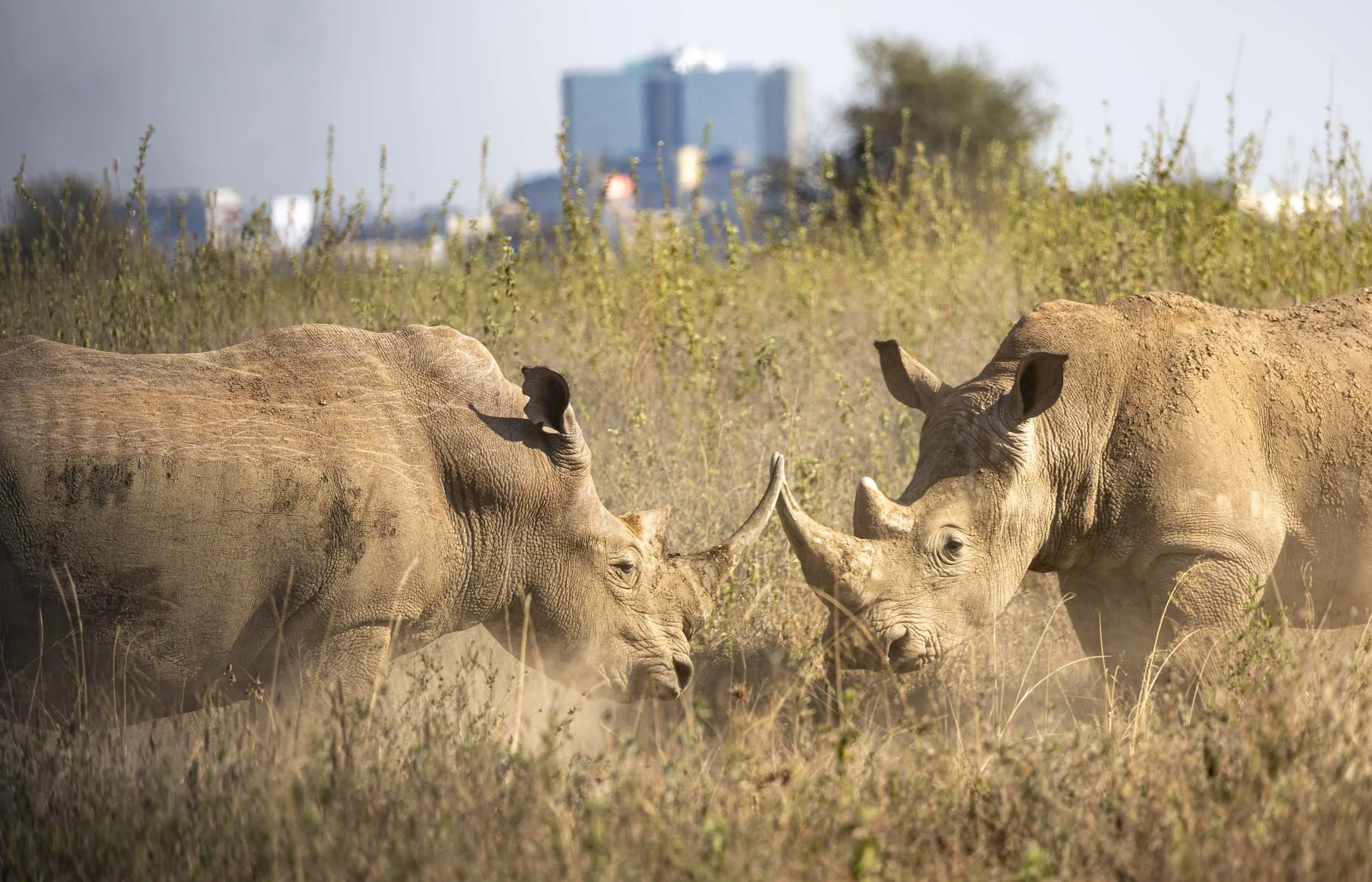
I had been hoping to capture an image of a rhino with the Nairobi skyline in the background, a photograph that instantly reveals the unique setting of this park.
At one point we encountered two white rhinos together in exactly this situation. One was lying on the ground while the other slowly circled it. Suddenly the larger rhino attempted to mount the resting animal, which immediately leapt to its feet. The two briefly squared off before eventually separating and walking away in different directions.
The entire interaction unfolded with the Nairobi skyline visible behind them, allowing me to capture a short series of images that perfectly illustrate the unusual contrast between wildlife and city.
Across the morning we probably saw around twenty individual rhinos in total, although many of them were distant and partially hidden in long grass.

Male white rhino tries to mount a female
Heat haze and photographic challenges
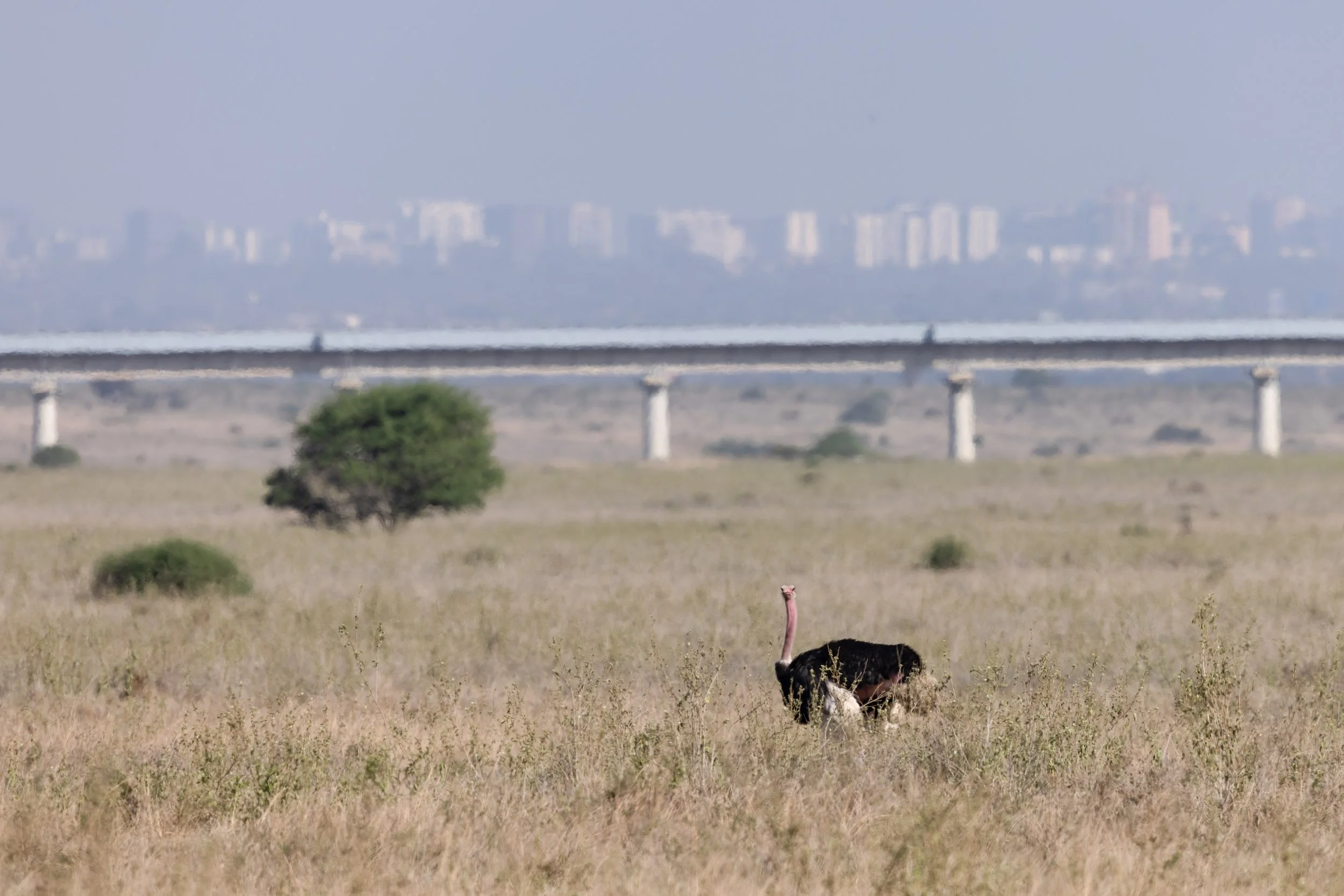
Male ostrich with elevated railway bridge and Nairobi city skyline
As the morning progressed the rising heat began to affect photography.
Heat haze can distort images in a number of ways. Most photographers recognise the shimmering mirage effect caused by warm air rising from the ground, but distortion can also come from other sources.
Heat rising from vehicle engines, air temperature differences between the inside and outside of a vehicle, and even warm air trapped inside a lens hood can sometimes affect long-lens photography.
On this occasion the effect was clearly visible when photographing a distant male ostrich with a bright red neck, a sign that it was in breeding condition. Although the bird itself was interesting, the heat distortion created a noticeably soft and shimmering image.
It was a useful reminder that environmental conditions can influence image quality just as much as camera settings.
The railway bridge
One of the most striking visual elements within Nairobi National Park is the elevated railway bridge that crosses part of the landscape.
The structure forms part of the Kenya Standard Gauge Railway linking Mombasa and Nairobi, which opened in 2017. Built as a raised viaduct, the railway was designed to allow wildlife to pass beneath it rather than dividing the park entirely.
Despite these mitigation measures, the construction of the railway through Kenya’s oldest national park generated considerable controversy at the time, with conservation groups raising concerns about its environmental impact.
Seeing modern railway infrastructure crossing a national park is unusual, but it also highlights the constant challenge of balancing development with conservation in a rapidly growing region.
Lunch with the baboons
Late in the morning we stopped at one of the park’s picnic sites for lunch.
Unfortunately the resident troop of baboons had clearly learned that these areas often meant food. Within minutes they began approaching the tables looking for opportunities.
At one point a particularly bold baboon reached between my legs in an attempt to grab the bag containing my packed lunch.
That was enough encouragement for us to retreat quickly to the safety of the safari vehicle where we finished lunch without further interruption.
Final thoughts
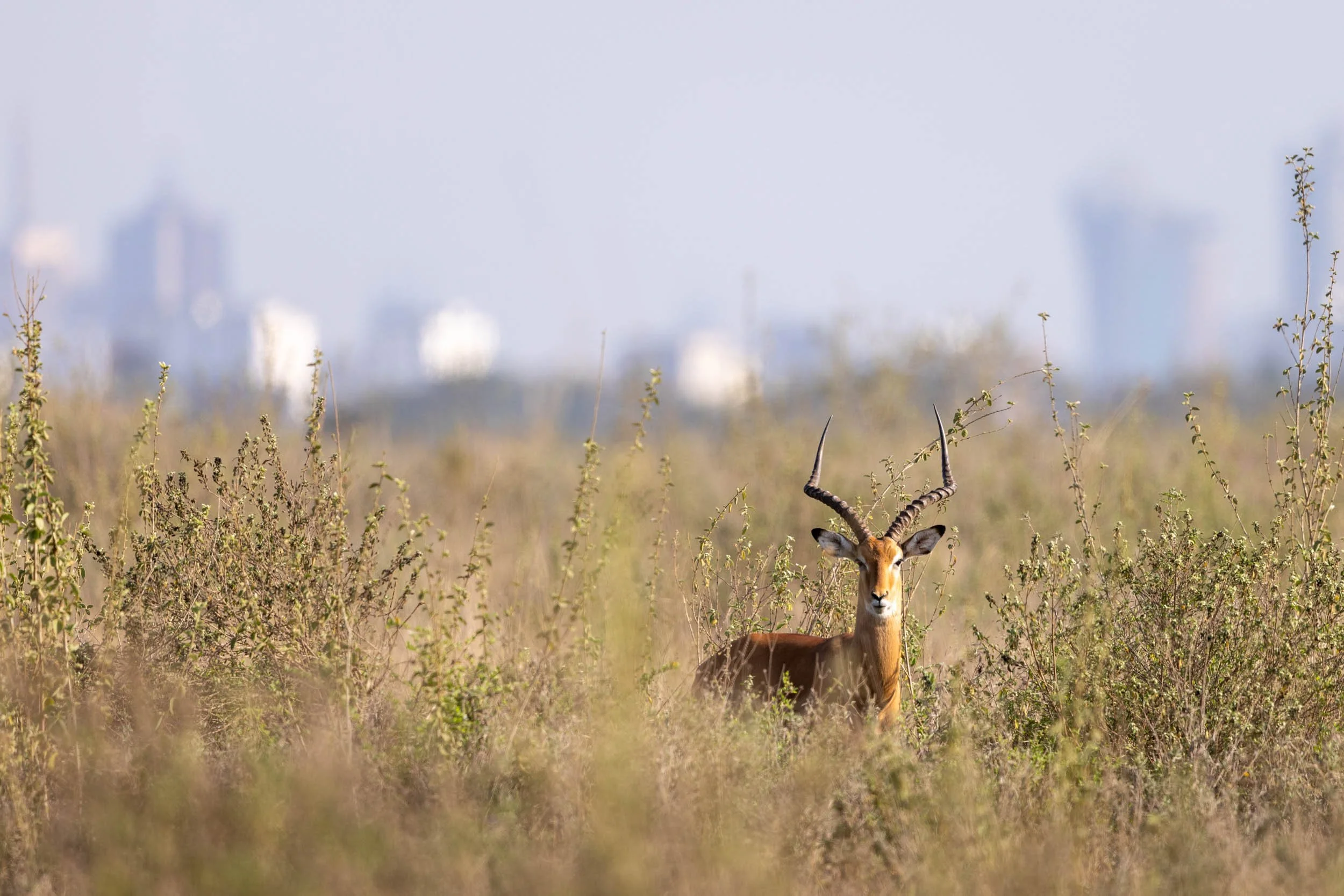
Male impala against the Nairobi city skyline
Wildlife sightings during my visit were fairly quiet overall. We saw zebra, ostriches, impala, vervet monkeys and a few red hartebeest, but no predators appeared during the morning.
The park itself also felt quieter than I expected for a Sunday morning, although it would have been interesting to see how many vehicles might have gathered had a predator been spotted.
Despite that, the safari served its purpose perfectly. It gave me the opportunity to begin photographing wildlife in Kenya, reacquaint myself with working from a safari vehicle, and start rebuilding the muscle memory that always takes a little time after travelling.
Tony proved to be an excellent guide throughout the morning, friendly, knowledgeable and clearly familiar with the park.
Nairobi National Park remains a genuinely unusual wildlife destination. Few places in the world allow photographers to capture images of rhinos with the skyline of a capital city rising behind them.
I am glad I visited the park and experienced it for myself, but it is not somewhere I would personally choose to return.
If I found myself back in Nairobi with a free day, I would probably choose a different wildlife experience instead, most likely visiting the Sheldrick Wildlife Trust elephant sanctuary, which rescues and rehabilitates young elephants from across Kenya.
My time in Nairobi National Park was only the beginning of my trip to Kenya, which would conclude at Amboseli National Park, where wildlife photography opportunities were very different.
Whatever you photograph, have fun.
If you are planning your own visit
Enter the park as early as possible to maximise wildlife activity
Consider organising park entry in advance if possible
Rhino sightings are among the best in Africa
Heat haze can affect long-distance photography later in the morning
The Nairobi skyline creates unique photographic opportunities
Useful links
This guide is part of my On Location wildlife photography series, where I share practical advice and real life experiences from photographing wildlife in the UK, Europe and Africa.